

Schema Therapy in Greenville, SC
Comprehensive Program
When You Understand Your Patterns...But They Keep Repeating
Have you ever found yourself asking:
"Why do I keep ending up here?"
Maybe you promised yourself you wouldn't enter another unhealthy relationship.
Yet somehow, months later, you realize you're living through the same story with a different person.
Or perhaps you know your inner critic is unfair.
You can even explain where it came from.
But understanding it hasn't stopped the shame.
Maybe you've spent years in therapy learning about your childhood, recognizing your triggers, and understanding your emotions.
Yet when life becomes stressful, the same reactions return.
You still feel unworthy.
You still fear rejection.
You still struggle to trust people.
You still believe you have to earn love instead of simply receiving it.
This can feel incredibly discouraging.
It's easy to wonder whether change is actually possible.
The good news is that understanding your patterns is only one part of healing.
Schema Therapy was developed to help people change the emotional patterns that continue long after they understand them intellectually.
At Upstate Integrative Mind Counseling, we provide Schema Therapy for adolescents and adults throughout Greenville and Upstate South Carolina who are ready to move beyond insight and create lasting emotional change.
What Is Schema Therapy?
Schema Therapy is an evidence-based approach developed by Dr. Jeffrey Young to help people identify and heal deeply rooted emotional patterns that often begin early in life.
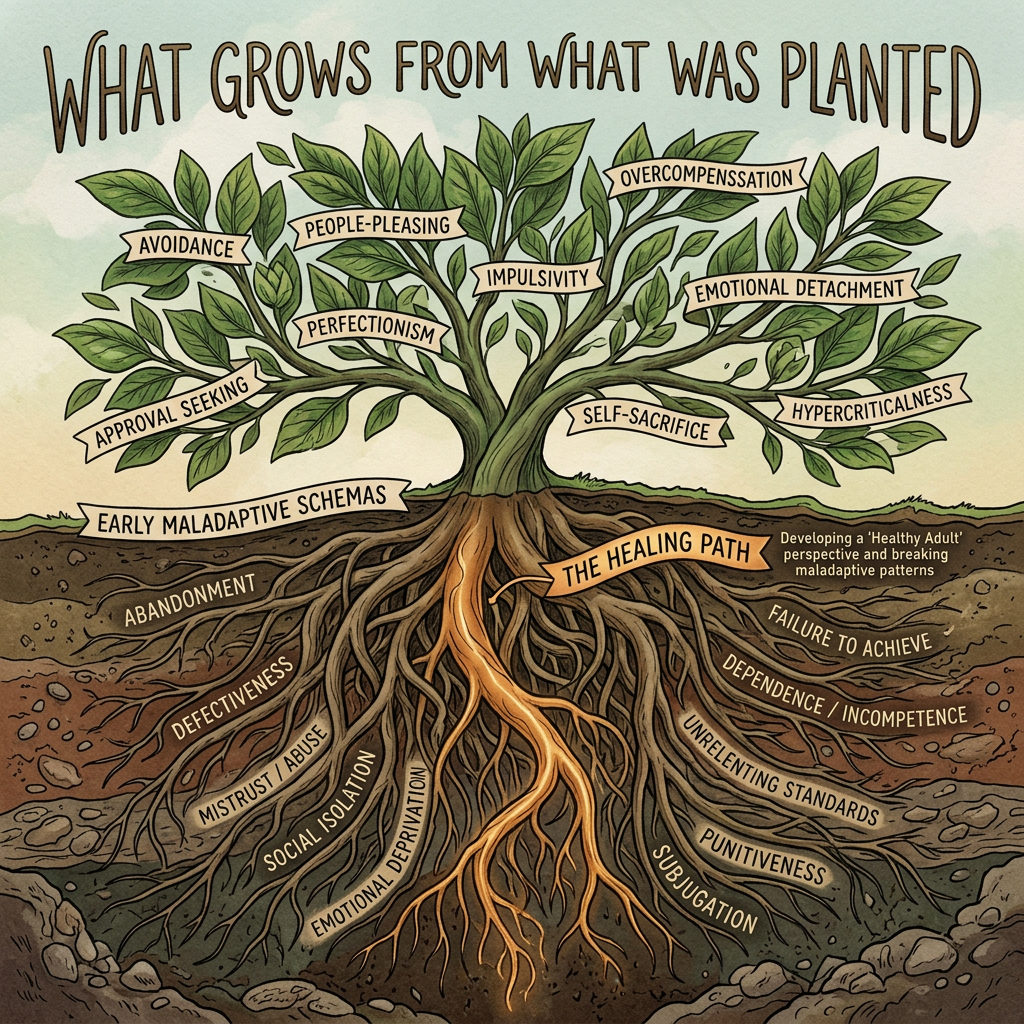
These patterns are called schemas.
Schemas are not simply negative thoughts.
They are deeply held beliefs about ourselves, other people, and the world that develop through repeated life experiences.
For example, someone may intellectually know they are worthy of love while emotionally believing they will eventually be abandoned.
Another person may know they don't have to be perfect but still feel overwhelming shame whenever they make a mistake.
These patterns often operate automatically.
Without realizing it, they influence how we think, feel, behave, and choose relationships.
Schema Therapy helps people recognize these lifelong patterns, understand where they came from, and gradually develop healthier ways of relating to themselves and others.
What Are Schemas?
Think of a schema as the emotional "lens" through which you experience the world.
That lens influences what you notice.
How you interpret situations.
What you expect from other people.
How you respond when you're hurt.
Schemas often begin developing in childhood when important emotional needs are not consistently met.
Those needs might include:
Safety
Love and connection
Acceptance
Healthy independence
Validation
Appropriate limits
Emotional expression
Children naturally try to make sense of difficult experiences.
Sometimes they develop beliefs that help them survive.
Examples include:
"I'm too much."
"I'm not enough."
"People always leave."
"I have to take care of everyone else."
"If I make a mistake, people won't love me."
"My needs don't matter."
These beliefs may have helped a child adapt to difficult circumstances.
As adults, however, they often continue operating even when life has changed.
How Do Schemas Affect Adult Life?
Schemas don't stay in childhood.
They quietly shape many areas of adult life.
They influence:
Romantic relationships
Friendships
Parenting
Self-esteem
Career decisions
Boundaries
Anxiety
Depression
Emotional reactions
You may find yourself repeatedly:
Choosing emotionally unavailable partners.
Feeling responsible for everyone else's emotions.
Avoiding conflict at all costs.
Feeling like an imposter despite success.
Believing you must earn rest.
Expecting rejection even from people who care about you.
These aren't character flaws.
They're often longstanding survival strategies that no longer serve you.
How Do You Know If Schema Therapy Might Help?
Schema Therapy may be helpful if you:
Keep repeating the same painful relationship patterns.
Struggle with chronic shame or self-criticism.
Feel emotionally "stuck."
Understand your problems but continue repeating them.
Experience strong emotional reactions that seem larger than the situation.
Feel unworthy despite evidence to the contrary.
Have difficulty trusting others.
Grew up with childhood trauma, neglect, criticism, or inconsistent caregiving.
Struggle with perfectionism or people-pleasing.
Feel like part of you never truly believes you're safe.
Many people seek Schema Therapy after trying other therapies and finding that insight alone wasn't enough to create lasting change.
Why Doesn't Insight Always Create Change?
This is one of the most common frustrations people bring into therapy.
They understand their childhood.
They understand their attachment style.
They understand their triggers.
Yet emotionally...
Nothing feels different.
That's because emotional learning happens differently than intellectual learning.
Your thinking mind may understand something years before your emotional brain fully believes it.
Schema Therapy helps bridge that gap.
Rather than simply talking about your experiences, therapy focuses on creating new emotional experiences that gradually reshape deeply rooted beliefs.
Healing happens not only through understanding but through experiencing relationships, emotions, and yourself differently.
What Happens During Schema Therapy?
Schema Therapy combines several evidence-based approaches into one comprehensive treatment.
Depending on your needs, therapy may include:
Identifying Core Schemas
Learning to recognize the emotional patterns that have shaped your life.
Understanding Coping Styles
Exploring how you learned to survive difficult experiences through avoidance, surrender, or overcompensation.
Working with Schema Modes
Understanding the different emotional "parts" that become active in different situations, such as the Vulnerable Child, Angry Child, Detached Protector, Punitive Parent, or Healthy Adult.
Healing Emotional Wounds
Using experiential techniques, imagery, and emotionally corrective experiences to address longstanding pain.
Building the Healthy Adult
Strengthening the part of you that can care for your emotions, set boundaries, make balanced decisions, and meet your needs in healthier ways.
What Concerns Can Schema Therapy Help Treat?
Schema Therapy has been shown to be effective for many concerns, including:
Chronic anxiety
Depression
Childhood trauma
Complex trauma
Personality disorders
Relationship difficulties
Low self-esteem
Perfectionism
People-pleasing
Emotional neglect
Attachment wounds
Chronic shame
Rather than focusing only on symptoms, Schema Therapy addresses the underlying emotional patterns that often keep symptoms returning.
How Is Schema Therapy Different from CBT?
Cognitive Behavioral Therapy (CBT) helps people identify and change unhelpful thoughts and behaviors occurring in the present.
Schema Therapy certainly includes cognitive and behavioral techniques, but it goes further by exploring how lifelong emotional patterns developed and why they continue.
Many people find Schema Therapy especially helpful when they understand their thoughts logically but continue feeling emotionally trapped in the same patterns.
The goal isn't simply to think differently.
It's to experience yourself differently.
Why Choose Upstate Integrative Mind Counseling?
At Upstate Integrative Mind Counseling, we believe lasting change happens when therapy addresses both the present and the past.
Our approach to Schema Therapy combines evidence-based techniques with compassion, collaboration, and curiosity.
Rather than asking, "What's wrong with you?"
We ask,
"What experiences shaped the way you learned to survive?"
Understanding your history isn't about assigning blame.
It's about creating freedom.
When your patterns finally make sense, they no longer have to define your future.
Frequently Asked Questions
Is Schema Therapy only for people with personality disorders?
No. While Schema Therapy has strong research supporting its use with personality disorders, it is also effective for many people struggling with anxiety, depression, trauma, perfectionism, relationship difficulties, and longstanding emotional patterns.
How long does Schema Therapy take?
The length of therapy depends on your goals and the patterns you're working to change. Because schemas often develop over many years, therapy is typically more in-depth than brief, symptom-focused treatment.
Can Schema Therapy help if I've already been in therapy?
Yes. Many people begin Schema Therapy after finding that previous therapy helped them understand their struggles but didn't fully change the emotional patterns underneath them.
What are Schema Modes?
Schema modes are the different emotional states or coping responses that become active throughout the day. Therapy helps you recognize these modes, understand why they developed, and strengthen your Healthy Adult mode so you can respond more intentionally to life's challenges.
You Are More Than the Patterns That Helped You Survive
The beliefs that shape your life today didn't appear overnight.
Many of them developed as creative ways to adapt to difficult circumstances.
They helped you survive.
But survival isn't the same as healing.
Schema Therapy offers the opportunity to understand where those patterns began, meet the emotional needs that were left unmet, and gradually create new ways of relating to yourself and the people you love.
If you're ready to move beyond simply understanding your story and begin changing it, Upstate Integrative Mind Counseling is here to walk alongside you.