

Structural Dissociation Treatment in Greenville, SC
Comprehensive Program
When It Feels Like Different Parts of You Are Pulling in Different Directions
Have you ever felt like part of you wants one thing while another part of you wants the exact opposite?
Part of you wants closeness.
Another part pushes people away.
Part of you knows you're safe.
Another part feels constantly on guard.
Part of you wants to move forward.
Another part feels frozen.
You may find yourself saying things like:
"I don't understand why I keep doing this."
"It's like a different part of me takes over."
"I know what I should do, but I can't seem to do it."
"Sometimes I don't even feel like myself."
These experiences can be confusing—and sometimes frightening.
Many people worry they're "going crazy."
In reality, these experiences are often understandable responses to overwhelming stress or trauma.
The Structural Dissociation Program at Upstate Integrative Mind Counseling helps individuals understand these internal experiences through a compassionate, evidence-based, trauma-informed approach that emphasizes safety, stabilization, and integration.
What Is Structural Dissociation?
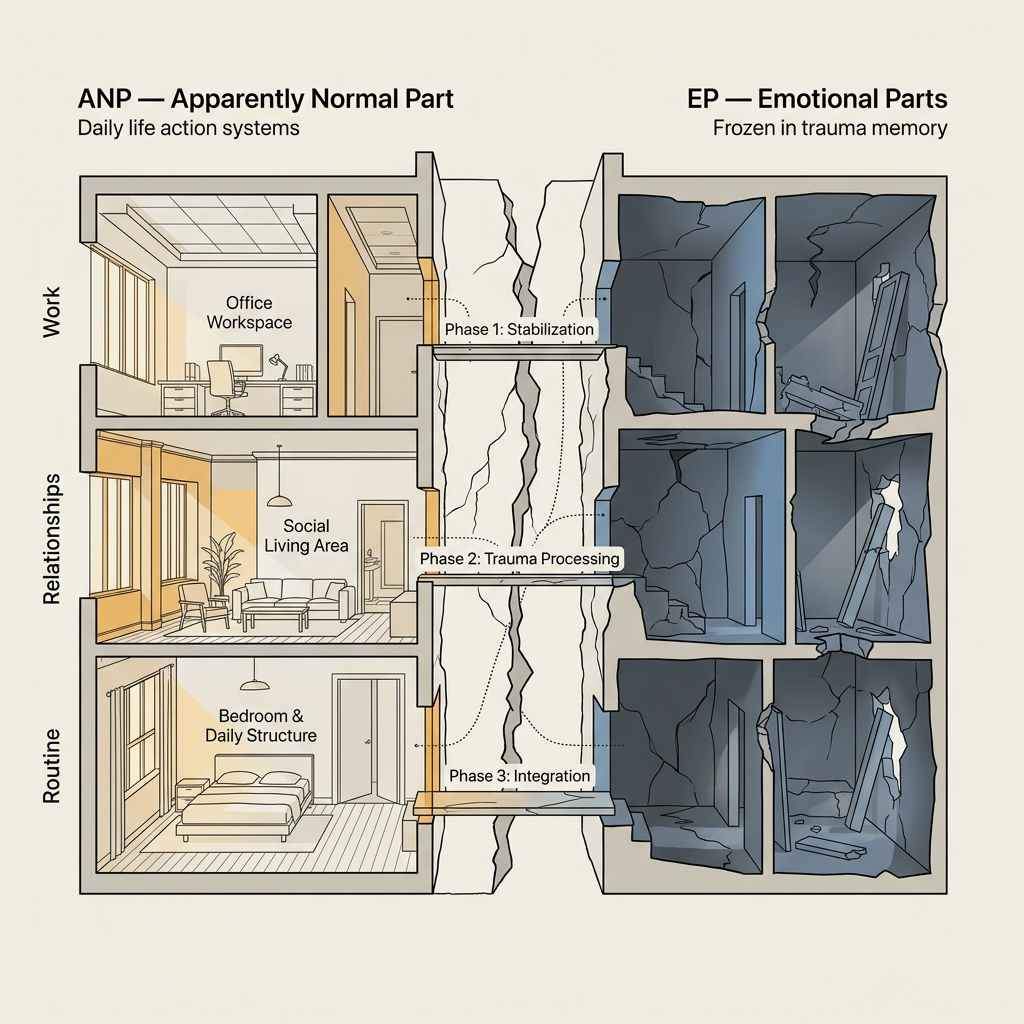
The Theory of Structural Dissociation explains how overwhelming or chronic trauma can affect the way the mind organizes itself.
Rather than experiencing ourselves as one completely unified system, different aspects of our personality may begin carrying different responsibilities.
Some parts focus on getting through everyday life.
Other parts continue carrying fear, pain, shame, anger, or traumatic memories.
These are not separate people.
They are understandable adaptations that developed to help someone survive overwhelming experiences.
When these different parts remain disconnected from one another, life can begin to feel confusing, exhausting, or unpredictable.
Therapy focuses on helping these parts communicate, cooperate, and gradually become more integrated over time.
What Does Dissociation Feel Like?
Many people imagine dissociation means completely "losing time."
While that can happen for some individuals, dissociation exists on a spectrum.
It may include experiences such as:
Feeling disconnected from yourself.
Feeling emotionally numb.
Watching yourself from the outside.
Feeling like the world isn't quite real.
Losing track of conversations.
Memory gaps.
Feeling like different parts of you have different opinions or emotions.
Suddenly feeling much younger during stressful situations.
Difficulty staying present.
Feeling detached from your body.
Finding yourself reacting in ways that don't make sense afterward.
These experiences are often the nervous system's way of protecting us from overwhelming emotions or memories.
Who May Benefit from the Structural Dissociation Program?
This program may be helpful for individuals experiencing:
Complex PTSD
Childhood trauma
Dissociative symptoms
Depersonalization
Derealization
Identity confusion
Internal conflict
Emotional overwhelm
Chronic shame
Attachment trauma
Developmental trauma
Difficulties regulating emotions
Many clients entering this program have spent years feeling misunderstood because their symptoms don't fit neatly into one diagnosis.
Why Do Different Parts Develop?
Our minds naturally try to protect us.
When life becomes overwhelming, especially during childhood, the brain sometimes organizes experiences in ways that allow us to continue functioning.
For example:
One part may continue going to school, working, parenting, or managing daily responsibilities.
Another part may continue carrying fear.
Another may hold grief.
Another may become highly protective.
These adaptations helped people survive.
Therapy isn't about getting rid of these parts.
It's about understanding why they developed and helping them work together instead of against one another.
What Does Treatment Look Like?
Our Structural Dissociation Program follows a phased, trauma-informed approach designed to prioritize safety before processing traumatic experiences.
Treatment often includes:
Phase One: Safety and Stabilization
Developing grounding skills, emotional regulation, nervous system stability, and communication among parts before deeper trauma work begins.
Phase Two: Trauma Processing
When appropriate, evidence-based trauma therapies such as EMDR, Deep Brain Reorienting (DBR), Schema Therapy, and other approaches may be integrated to help process unresolved traumatic experiences.
Phase Three: Integration and Reconnection
Strengthening cooperation among parts, increasing daily functioning, building healthier relationships, and creating a greater sense of wholeness.
Healing rarely happens by forcing painful memories to the surface.
Instead, therapy moves at a pace that respects your nervous system's readiness.
Our Integrative Approach
Because trauma affects every person differently, treatment is individualized.
Depending on your needs, therapy may integrate:
EMDR
Deep Brain Reorienting (DBR)
Schema Therapy
Dialectical Behavior Therapy (DBT)
Radically Open DBT (RO-DBT)
Mindfulness
Attachment-focused interventions
Ego State interventions
Parts work
Rather than relying on one approach for everyone, we develop a treatment plan that fits your history, symptoms, strengths, and goals.
Why Choose Upstate Integrative Mind Counseling?
Dissociation is often misunderstood.
Many individuals spend years believing something is fundamentally wrong with them when, in reality, their minds developed remarkable ways to survive overwhelming experiences.
Our approach emphasizes compassion rather than fear.
Curiosity rather than judgment.
Collaboration rather than control.
We believe healing happens when every part of you is understood—not criticized.
Frequently Asked Questions
Does having "parts" mean I have Dissociative Identity Disorder (DID)?
No. Most people experience different aspects of themselves in different situations. Structural dissociation exists on a spectrum, and many people experiencing internal conflict or dissociation do not have DID.
Will therapy make my symptoms worse?
Treatment moves at a pace designed to promote safety and stability. The goal is not to overwhelm you but to build the skills and resources needed for lasting healing.
Is this program only for severe trauma?
No. Many people with childhood emotional neglect, attachment wounds, chronic stress, or complex trauma benefit from this approach even if they don't identify with a specific dissociative disorder.
Will I have to talk about everything that happened?
Not immediately. Therapy focuses first on creating safety, stability, and trust. Trauma processing occurs only when you and your therapist determine that it is clinically appropriate.
Healing Doesn't Mean Becoming Someone New
Many people come to therapy believing they need to get rid of certain parts of themselves.
Healing looks different.
It's learning that every part of you developed for a reason.
The parts that protected you.
The parts that carried fear.
The parts that kept going when life felt impossible.
They all deserve understanding.
Through compassionate, evidence-based treatment, it becomes possible to move from surviving in pieces toward living with greater connection, stability, and wholeness.
If you're ready to better understand your experiences with dissociation, trauma, or internal conflict, Upstate Integrative Mind Counseling is here to help.