

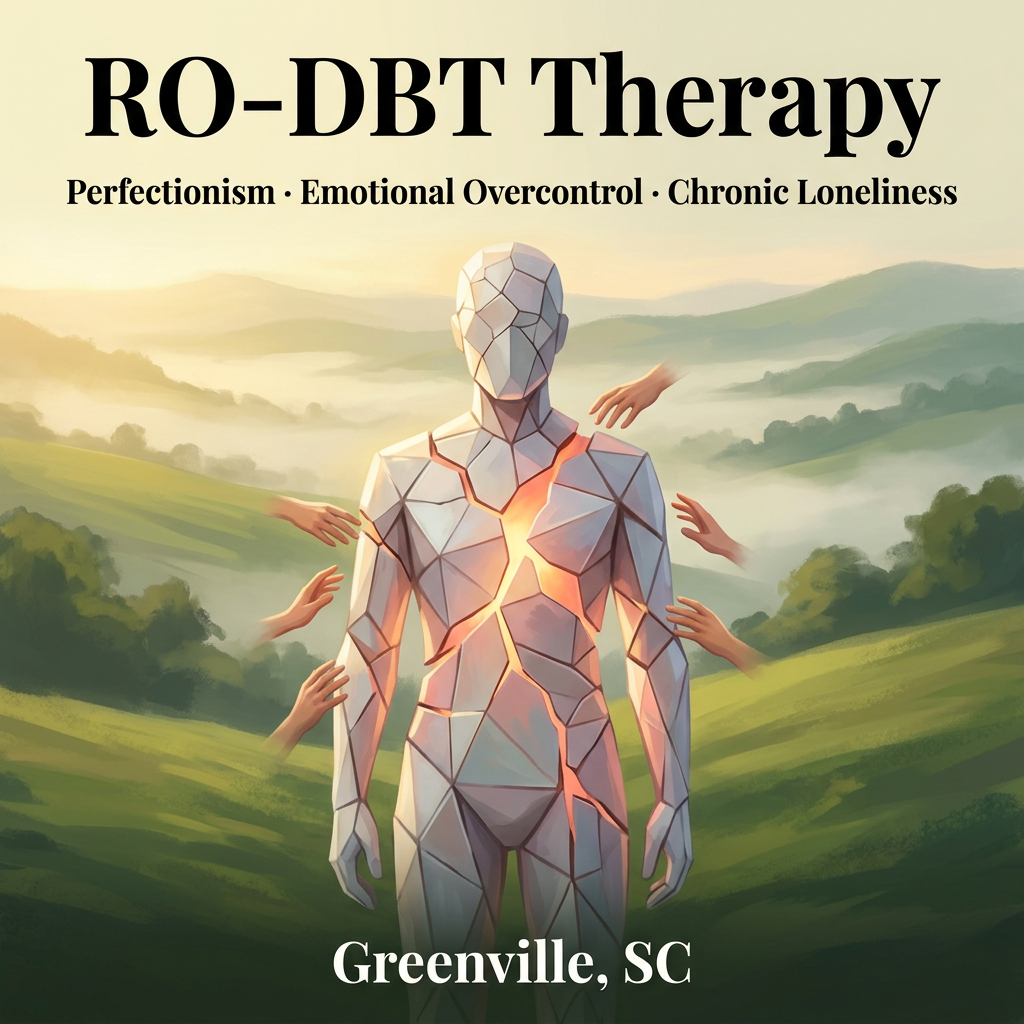
RO-DBT Therapy for Perfectionism, Emotional Overcontrol, and Chronic Loneliness in Greenville, SC
Comprehensive Program
When Self-Control Stops Working
Most people think emotional suffering looks obvious.
They imagine someone who can't control their emotions, acts impulsively, or feels overwhelmed by every challenge.
But there is another kind of suffering that's much easier to miss.
It often hides behind achievement.
Behind responsibility.
Behind being "the dependable one."
You may be the person everyone counts on.
You rarely miss deadlines.
You keep your promises.
You work hard.
You avoid burdening others with your problems.
People may even describe you as calm, composed, successful, or incredibly disciplined.
Yet inside, life feels very different.
You may constantly wonder if you've done enough.
You replay conversations long after they've ended.
You notice every mistake you make but struggle to recognize your successes.
You feel uncomfortable asking for help, even when you're overwhelmed.
You long for close relationships, but something always seems to stay just out of reach.
People often tell you to "lighten up" or "stop overthinking."
If only it were that simple.
Many people who struggle this way aren't lacking self-control.
They've developed too much.
Radically Open Dialectical Behavior Therapy (RO-DBT) is an evidence-based treatment designed specifically for people whose greatest strengths—discipline, conscientiousness, perfectionism, and self-control—have gradually become barriers to flexibility, joy, and authentic connection.
At Upstate Integrative Mind Counseling, we provide RO-DBT therapy for adults throughout Greenville and Upstate South Carolina who are ready to move beyond simply functioning and begin experiencing a fuller, more connected life.
What Is RO-DBT?
Radically Open Dialectical Behavior Therapy (RO-DBT), developed by Dr. Thomas Lynch, is an evidence-based treatment for individuals who cope through overcontrol rather than undercontrol.
While many therapies focus on helping people gain greater self-control, RO-DBT recognizes that some people already have an abundance of it.
They carefully monitor themselves.
They think before they speak.
They suppress emotional reactions.
They hold themselves to exceptionally high standards.
They strive to do the "right" thing.
These qualities often lead to success in school, careers, and many areas of life.
But when self-control becomes excessive, it can also create unexpected problems.
Life begins to feel rigid.
Mistakes become intolerable.
Relationships become difficult to relax into.
Authenticity gives way to performance.
The very strategies that once helped you succeed begin to isolate you from the people and experiences that matter most.
RO-DBT helps loosen these patterns—not by encouraging people to become careless or irresponsible, but by helping them become more psychologically flexible, emotionally open, and socially connected.
What Is Overcontrol?
Overcontrol isn't a diagnosis.
It's a coping style.
It develops when a person learns that being careful, prepared, responsible, or emotionally restrained is the safest way to navigate life.
For many people, these strategies were adaptive.
Perhaps mistakes were criticized.
Maybe emotions weren't welcomed.
Perhaps achievement became the way to earn acceptance.
Or maybe your temperament naturally leaned toward caution and conscientiousness.
Whatever the reason, overcontrol often begins as protection.
The difficulty is that what protects us in one season of life can begin to limit us in another.
Over time, excessive self-control can make it harder to:
Form close relationships.
Ask for help.
Recover from mistakes.
Adapt to unexpected change.
Experience spontaneity.
Express emotions openly.
Feel a genuine sense of belonging.
RO-DBT isn't about eliminating your strengths.
It's about helping those strengths work for you instead of against you.
How Do You Know If RO-DBT Might Help?
You may benefit from RO-DBT if you:
Hold yourself to standards you would never expect of others.
Feel guilty relaxing or taking breaks.
Constantly replay conversations in your mind.
Struggle to receive compliments.
Find it difficult to express emotions openly.
Feel lonely even when surrounded by people.
Prefer handling problems alone.
Worry about appearing weak or incompetent.
Feel uncomfortable when plans change unexpectedly.
Tend to think in terms of "should," "must," or "have to."
Experience chronic anxiety despite being highly capable.
Feel successful on the outside but emotionally exhausted on the inside.
Not everyone with overcontrol experiences every one of these patterns.
Some people primarily struggle with perfectionism.
Others experience chronic loneliness.
Others simply feel like life has become increasingly rigid and joyless.
Why Doesn't More Self-Discipline Solve the Problem?
This is one of the biggest misconceptions people bring into therapy.
If you've always succeeded by trying harder, it's natural to assume the answer is simply to become even more disciplined.
But overcontrol isn't caused by a lack of discipline.
It's caused by relying on discipline for nearly everything.
When every mistake feels significant...
When vulnerability feels risky...
When asking for help feels uncomfortable...
Trying harder often deepens the very patterns you're trying to escape.
RO-DBT offers a different path.
Rather than asking, "How can I control myself better?"
It begins asking questions like:
What would happen if I became a little more flexible?
What if being genuine mattered more than being perfect?
How might my relationships change if people could see more of the real me?
How Is RO-DBT Different from DBT?
Although the names sound similar, DBT and RO-DBT were developed for different patterns of coping.
Traditional DBT helps people whose emotions often become larger than their ability to manage them.
RO-DBT helps people whose self-control has become so strong that emotions, needs, and vulnerability are often kept hidden.
Both approaches value mindfulness, acceptance, and meaningful change.
The difference lies in the direction of growth.
DBT often helps people develop greater stability.
RO-DBT helps people develop greater openness.
For some individuals, learning to pause before reacting changes their lives.
For others, learning to let others see them changes everything.
What Will I Learn in RO-DBT?
RO-DBT focuses on developing the skills needed to build a life that is not only successful but deeply connected.
Treatment includes learning how to:
Develop Radical Openness
Become more willing to question assumptions, tolerate uncertainty, and remain open to new information—even when it's uncomfortable.
Increase Psychological Flexibility
Move away from rigid rules and toward responses that fit the situation rather than habitual patterns.
Strengthen Social Signaling
Learn how facial expressions, body language, tone of voice, and emotional expression influence connection with others.
Build Authentic Relationships
Practice vulnerability, openness, and genuine emotional expression in ways that deepen trust and belonging.
Reduce Perfectionism and Self-Criticism
Replace relentless self-evaluation with curiosity, self-compassion, and realistic expectations.
What Does RO-DBT Treatment Look Like?
RO-DBT is an active, collaborative therapy.
Treatment may include:
Individual therapy
RO-DBT skills classes or groups
Behavioral experiments
Mindfulness and self-enquiry practices
Real-world exercises to increase openness and flexibility
Rather than focusing solely on symptom reduction, RO-DBT helps clients build lives that feel richer, more connected, and more emotionally fulfilling.
Is RO-DBT Right for Anxiety or Depression?
Yes—but not all anxiety or depression looks the same.
RO-DBT is especially helpful when anxiety or depression exists alongside patterns of overcontrol.
For example, people may experience:
Perfectionism
Chronic worry
Social isolation
High-functioning depression
Obsessive-compulsive personality traits
Restrictive eating disorders
Burnout
Emotional loneliness
Rather than focusing only on reducing symptoms, RO-DBT helps address the underlying coping style that often keeps these struggles going.
Why Choose Upstate Integrative Mind Counseling?
At Upstate Integrative Mind Counseling, we understand that some of the people who suffer the most are often the ones others admire.
They are thoughtful.
Responsible.
Reliable.
Hardworking.
From the outside, they appear to have everything together.
Our goal isn't to help you become someone different.
It's to help you experience greater freedom within the life you've already worked so hard to build.
Through evidence-based RO-DBT, we help clients move beyond perfectionism and emotional overcontrol toward flexibility, belonging, and genuine connection.